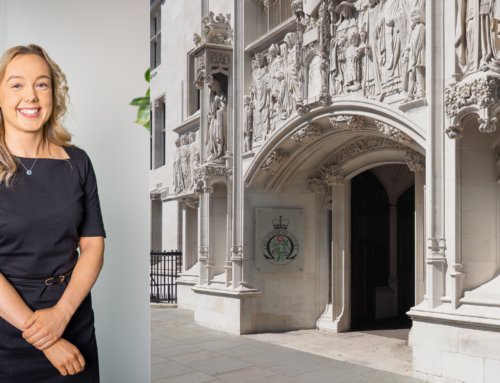


Partner Stephanie Douthwaite discusses with host David Opie, on Today’s Family Lawyer the rapidly growing trend of clients arriving at initial consultations having relied on artificial intelligence to outline their own divorce settlements. Click the podcast logo to listen.
AI is changing the way we do almost everything, including how we approach divorce.
With tools like ChatGPT offering instant answers to legal questions, it’s understandable that separating couples are turning to AI to help them navigate the process, work out a financial settlement, or even challenge their solicitor’s advice.
Why wouldn’t they? If you’re already worried about the cost of divorce, free answers are appealing.
However, there’s a growing misconception that using AI to do some of the legal groundwork yourself will automatically save you money.
In reality, it could end up costing you more.
When an AI-generated divorce settlement isn’t what it seems
Imagine you and your former partner want to keep things amicable. You’ve agreed that neither of you wants an expensive legal battle, so you enter details of your finances into ChatGPT and ask it to suggest a fair settlement.
Within seconds, you have what looks like a reasonable agreement. You both feel comfortable with it and approach a solicitor to make it legally binding.
Surely that’s the expensive part taken care of?
Not necessarily.
A financial settlement on divorce is rarely as straightforward as dividing everything down the middle. What appears fair on paper may not be fair in practice, particularly when pensions, business interests, property, future earning capacity or differing financial needs are involved.
AI can only work with the information it’s given. It doesn’t know whether your spouse has fully disclosed their assets, whether a business has been valued correctly or whether the proposed division will leave one person financially vulnerable in the future.
It may also overlook tax implications, pension considerations or the practicalities of implementing an agreement.
When a solicitor reviews that proposed settlement, they have a responsibility to identify these issues and explain the potential consequences.
That can mean going back through the financial information, questioning assumptions, requesting further disclosure and potentially renegotiating an agreement you thought was already settled.
Instead of saving legal fees, you’ve created additional work that might have been avoided with the right advice at the outset.
When ChatGPT becomes your second solicitor
There’s another trend we’re seeing in family law: people using AI to scrutinise every piece of advice or correspondence they receive from their solicitor.
Again, I understand the temptation.
You receive an email from your solicitor explaining a proposed settlement or the next steps in your divorce. You copy it into an AI tool and ask whether the advice is correct, what questions you should be asking or whether there’s a better approach.
The result might be a lengthy list of questions, alternative arguments and potential problems.
Some may be perfectly reasonable. Others might be irrelevant, based on incorrect legal principles or simply not applicable to your circumstances.
However, when you send those questions back to your solicitor, they still need to consider and respond to them appropriately.
And that takes time.
Time spent explaining why an AI-generated argument doesn’t apply to your case, correcting misinformation or revisiting advice you’ve already received is time you’re potentially paying for.
Of course, you should always feel comfortable questioning your solicitor and understanding the advice you’re given. A good family lawyer should welcome meaningful questions – but there’s a difference between asking for clarity and generating unnecessary work based on information that may not be accurate.
AI doesn’t know what matters most in your divorce
One of the biggest challenges with AI is that it can deliver an answer that sounds authoritative, even when it’s wrong.
Family law in England and Wales isn’t a simple formula. There is no automatic entitlement to a 50/50 division of assets in every divorce, and two couples with seemingly similar finances can reach very different settlements depending on their circumstances.
A solicitor brings something AI cannot reliably replicate: professional judgement built on experience.
We consider not only what the law says, but how it applies to your individual circumstances, what a court might consider fair, where the risks lie and how best to negotiate an outcome that protects your future.
That becomes particularly important when one spouse controls the finances, there are complex business interests or trusts, or the relationship involves conflict or controlling behaviour.
Sometimes the most valuable advice is knowing which issues are worth pursuing and which aren’t.
A lengthy AI-generated list of possible legal arguments might look impressive, but pursuing every point can increase conflict, delay negotiations and add significantly to costs without improving the outcome.
The hidden risk of sharing your financial information
There’s another issue worth considering before uploading your divorce documents, solicitor correspondence or financial information into a public AI tool: confidentiality.
Divorce proceedings can involve highly sensitive personal and financial information, including business accounts, pension details, property valuations and information about children.
Uploading confidential documents or legal advice to an AI platform without understanding how that information is stored or used may create privacy risks and could potentially compromise legal professional privilege.
It’s important to understand the privacy settings and safeguards of any tool before sharing sensitive information.
So, should you avoid AI altogether?
Not at all.
AI can be useful for understanding unfamiliar terminology, learning about the broad stages of divorce or helping you organise your thoughts before speaking to a solicitor.
Used appropriately, it can make an unfamiliar process feel less daunting.
My advice is to use it to help you understand the process, not to replace the professional advice that will shape your financial future.
If you’re concerned about legal fees, have an open conversation with your solicitor about costs, priorities and how you can work together efficiently.
Ask what information they need from you, which questions are important and where your time and money are best spent.
The objective should be to resolve matters fairly and efficiently, not to generate more work for everyone involved.
The cheapest divorce isn’t always the one that costs the least today
I understand why people want to keep the cost of divorce down. Legal fees can feel like another financial burden at an already difficult time.
A settlement that looks inexpensive today could prove extremely costly if it overlooks a pension, fails to account for future needs or leaves you without the financial protection you thought you had.
If your solicitor has to spend additional time unpicking an AI-generated agreement or responding to unnecessary questions, the savings you hoped to make can quickly disappear.
The best way to control your legal costs is to get the right advice, at the right time, and focus on the issues that genuinely matter.
AI might give you an answer in seconds. When it comes to your divorce, however, getting the right answer is far more important.
About Stephanie Douthwaite
Stephanie Douthwaite is a Partner and specialist family law solicitor at Harrogate Family Law, advising clients on complex financial settlements, business interests, wealth protection and divorce.
Stephanie is experienced in helping couples resolve matters constructively through negotiation, collaborative law and other non-court approaches, while ensuring their financial interests are properly protected.
If you’re considering divorce or have reached an agreement with your former partner and want to make sure it’s fair and legally secure, Stephanie and the team can help.
Call 01423 594680 or visit harrogatefamilylaw.co.uk to arrange an initial meeting.